Jack Services has introduced drone‑enabled pure‑water cleaning in 2026 because the technology has finally reached the level of safety, stability, and reliability our clients deserve. Earlier versions of cleaning drones were limited — they lacked precision, had short flight times, and did not meet our standards for safety, control, and consistent cleaning quality. Over the last few years, major advancements in flight stabilization, safety sensors, tethered power systems, and pure‑water delivery have made drone cleaning not only viable but highly effective.By 2026, the technology has matured enough to become a dependable part of our building‑maintenance solution suite. This timing ensures that our clients receive the benefits of innovation without the risks of early‑stage experimentation. We chose to adopt drones now because it’s the point where quality, safety, efficiency, and cost‑effectiveness intersect — allowing Jack Services to expand capabilities while still delivering the high‑standard results we are known for.
Pure‑water cleaning eliminates spotting, reduces environmental impact, and produces long‑lasting results.For clients seeking a modern, reliable, and forward‑thinking maintenance partner, Jack Services provides the technology, experience, and care to make every building look its best.The History of Drones for Building Maintenance
A Brief History of Drone Technology in Building Maintenance & Window WashingOver the last decade, drones have rapidly transformed from niche aerial tools into essential technology across multiple industries—including building maintenance and exterior window cleaning. Their evolution marks a major step forward in safety, efficiency, and modern facility care
.Early Exploration (2010–2015)
Drones initially entered the building services field as inspection tools. Early models were used to photograph rooftops, façades, and infrastructure, helping maintenance teams identify repairs without ladders or lifts. At this stage, drones were not equipped to clean, but they proved their value in difficult‑to‑reach areas and set the foundation for expanded use.
Prototype Cleaning Systems (2015–2018)
As drone capabilities grew, innovators began experimenting with attaching sprayers and water systems. These early prototypes were limited—offering basic spraying functions with minimal control—but represented the first steps toward aerial cleaning applications. They sparked industry interest and demonstrated that drones could do more than inspect.
Commercial Advancements (2019–2021)
By the late 2010s, drone cleaning technology accelerated. Companies in Europe, Asia, and the United States began developing stabilized, tethered drones capable of delivering water or cleaning solutions with greater precision. These systems introduced early automation, safety sensors, and improved maneuverability. For the first time, drones were seen as a viable supplement—or alternative—to lifts, scaffolding, and rope access.
Modernization & Pure‑Water Integration (2022–2024)
The next leap came with the integration of pure‑water technology. Pure, de‑ionized water leaves windows spotless without chemicals, making it an ideal pairing for drone‑based cleaning. Advanced systems allowed drones to deliver pure water at height with accuracy and consistency. The industry recognized drones as a safer and more efficient option for select building profiles, especially mid‑rise structures and challenging façade surfaces.Today’s Capabilities (2024–Present)
Today, drones play a growing role in exterior building maintenance. Modern systems feature:
• Precision flight controls
• Enhanced stabilization and safety redundancies
• Pure‑water delivery from ground‑based systems
• Environmentally friendly, chemical‑free cleaning
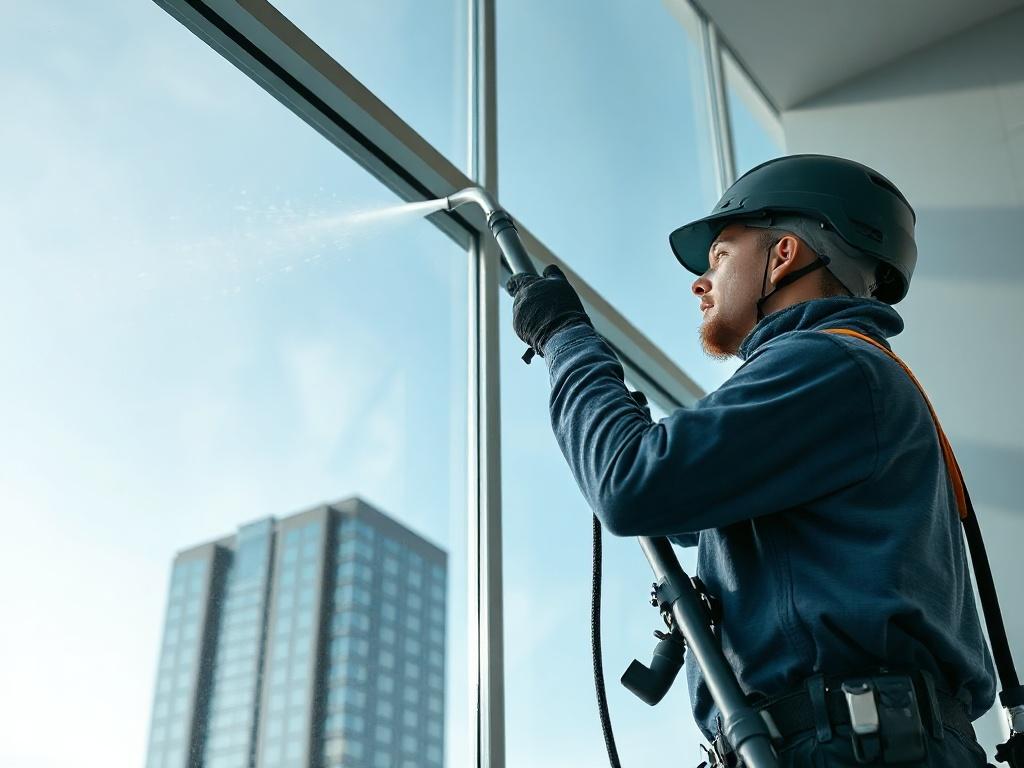
• Reduced need for lifts, scaffolding, and at‑height laborWhile not a replacement for all traditional methods, drones now serve as a highly effective tool—particularly when combined with advanced water‑fed poles capable of reaching up to seven stories from the ground. Together, these technologies offer a safer, cleaner, and more modern approach to building care.
The Future
Drone‑based cleaning continues to evolve, with ongoing developments in automation, battery performance, and sensor technology. As buildings grow more complex and clients seek safer and more efficient maintenance options, drones are poised to become a standard part of the industry’s toolkit.